I am an Indonesian astrophysics graduate student based in Sendai, Japan. My research focuses on galaxy evolution—particularly how massive galaxies form dense stellar cores, quench their star formation, and grow structurally over cosmic time. I work with spatially resolved SED fitting and multiwavelength observations from JWST, Hubble, and Chandra. Outside astronomy, I enjoy running, music, and photography.
BSc in Astronomy, Institut Teknologi Bandung, Indonesia (2020–2024)
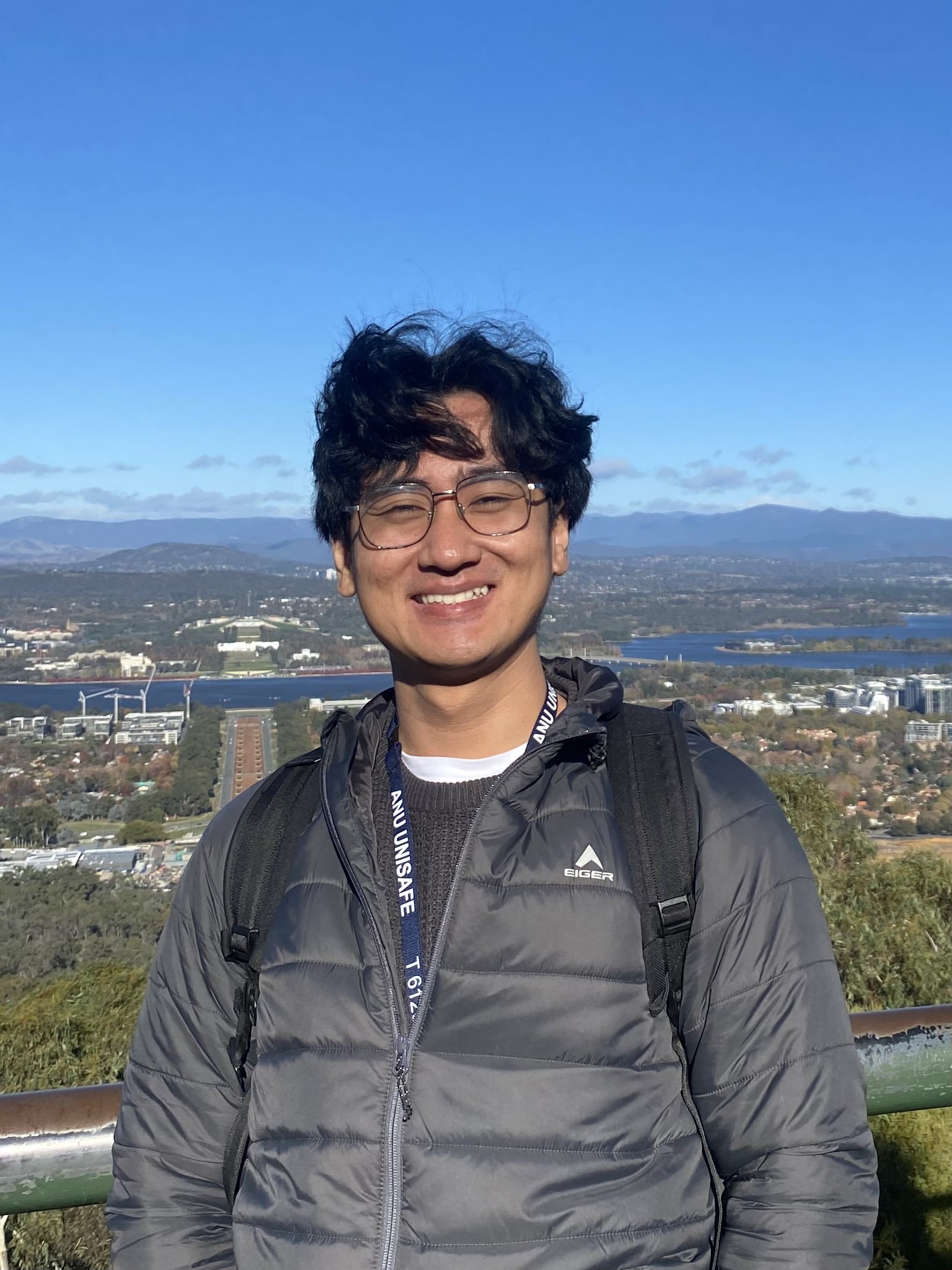
At Australian Parliament House, Canberra.
Research
My research investigates how the Universe's most massive galaxies assemble their stars, build dense central structures, stop forming new stars, and evolve into the giant elliptical galaxies seen today. I combine deep space-based imaging with spatially resolved spectral energy distribution fitting to map stellar mass and star formation within individual galaxies.
Interactive summary
Massive Galaxies Evolution
Move through cosmic time to see how stars become concentrated toward galaxy centers and how actively different regions continue forming new stars.
NowBig Bang
Selected cosmic epochLoading…
Loading radial_profiles_all_galaxies.txt…
Interactive galaxy atlas
Explore Individual Massive Galaxies
Each thumbnail can be viewed as a rest-frame UVJ image, stellar mass map, SFR map, or dust map while preserving its position in the stellar-mass–redshift plane. Click a galaxy to inspect its physical properties and resolved radial profiles.
Click a galaxy
Loading galaxy_gallery.csv…
Compaction, Quenching, and Black-Hole Growth
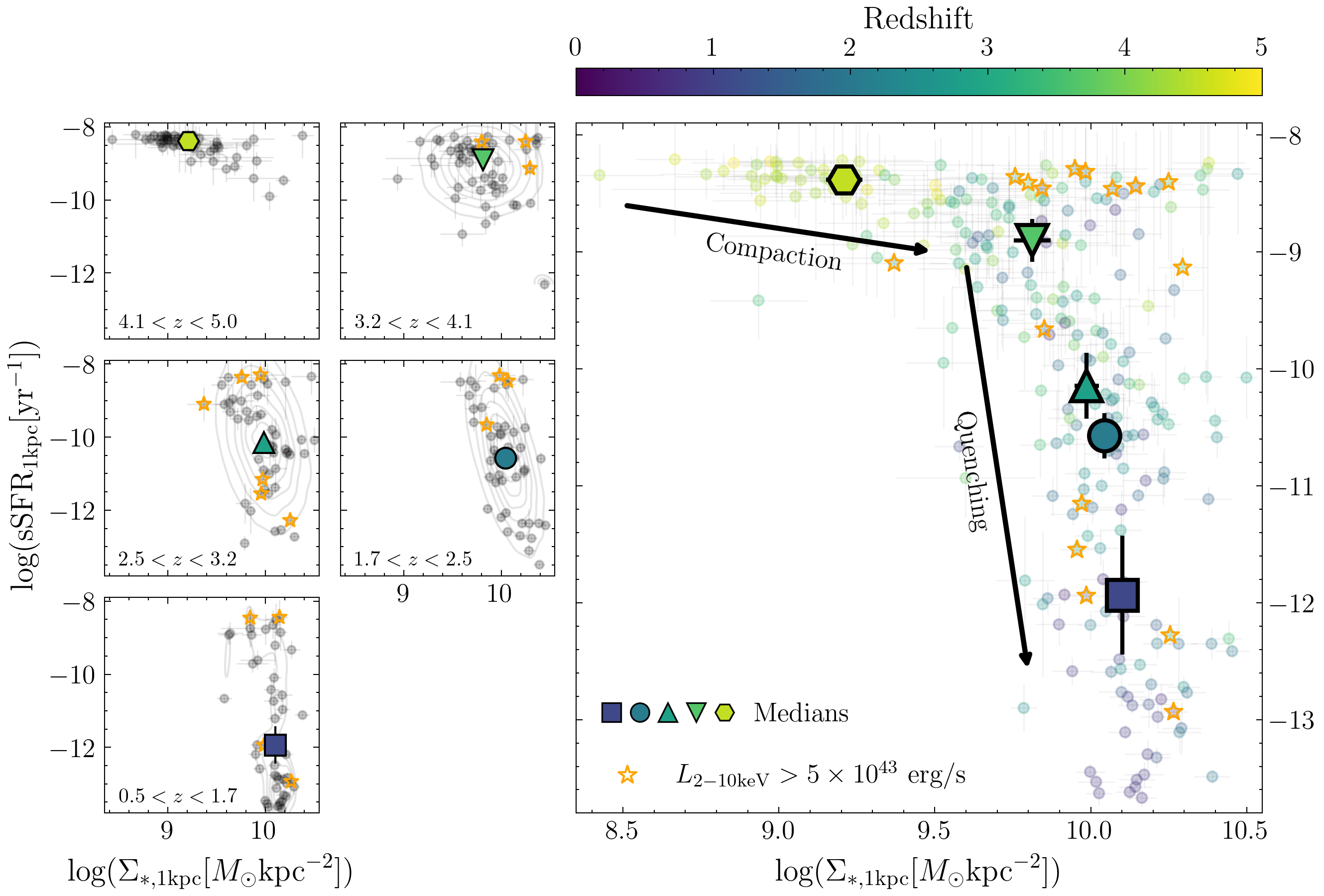
Using JWST imaging and Chandra X-ray observations, I study the most massive galaxies at z < 5. Their median central stellar mass increases by a factor of about seven over only ~400 million years around z ~ 4, followed by progressively stronger suppression of central star formation. X-ray-luminous active galactic nuclei are preferentially found in compact, star-forming systems, connecting dense-core formation with the growth of central supermassive black holes.
Evolution of central star formation and stellar mass density, illustrating the compaction–quenching sequence and the locations of X-ray-luminous AGN.
Post-quenching Evolution
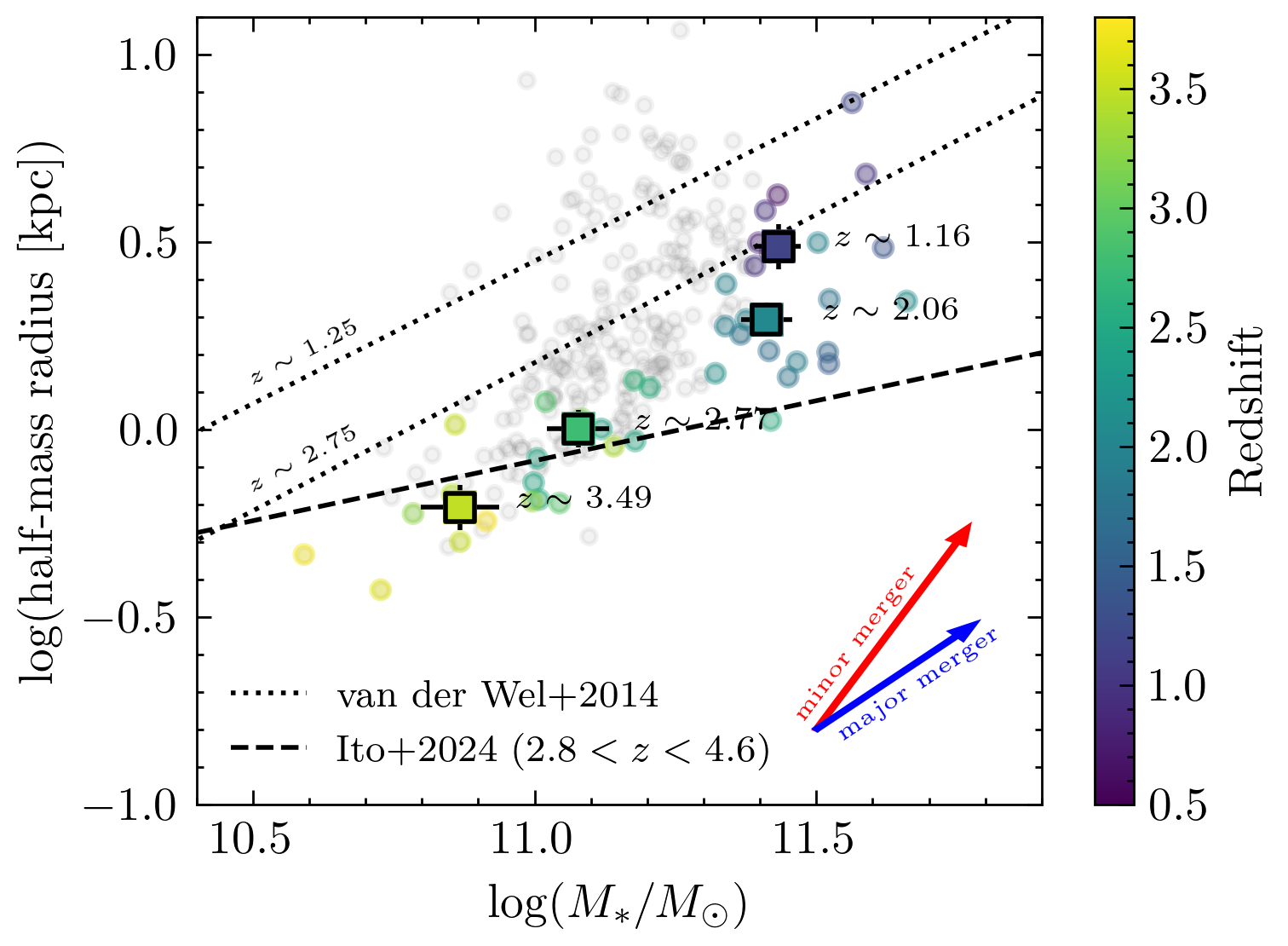
I also trace massive galaxies after their star formation has ended. Their dense central structures remain largely unchanged, while their outer regions continue to assemble stellar mass and their sizes increase by roughly a factor of five from z ~ 3.5 to z ~ 0.5. Residual star formation is insufficient to explain this growth, indicating that mergers are the main mechanism that transforms compact early galaxies into extended present-day systems.
Post-quenching evolution in the stellar mass–size plane, showing substantial size growth toward lower redshift.
Publications
Selected first-author work. Full author lists and bibliographic information are available through here.
Interplay of Compaction, Quenching, and Black Hole Growth in the Most Massive Galaxies since z ~ 5: Insights from JWST and Chandra Data
N. S. Haryana et al. — The Astrophysical Journal, 1009, 106 (2026)